
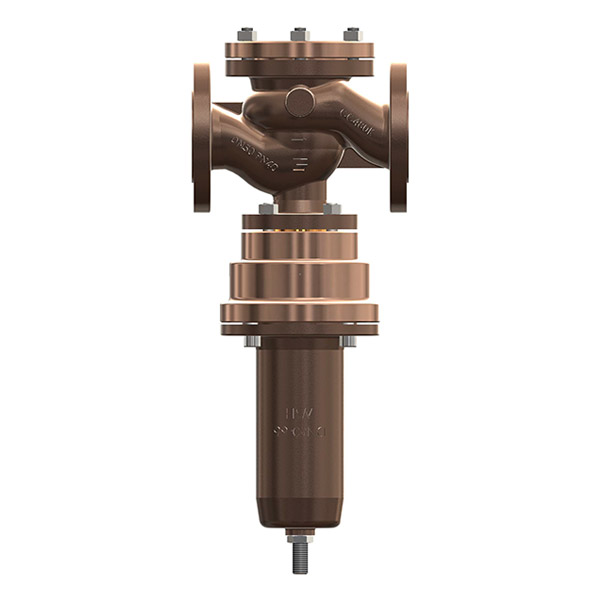
Wilhelm Schley trykkreduksjonsventiler
Beskrivelse
Selvbetjente trykkreduksjonsventiler for væsker og gasser.
The function of pressure reducing valves (pressure regulating valves) is, to reduce a varying or constant upstream pressure (inlet pressure) of the media to a constant reduced pressure (outlet pressure, back pressure) which is independent of the upstream pressure.
The pressure reduction occurs by throttling the free cross section between the seat and cone. Via a pulse line, which is already installed on the valve, the reduced pressure presses on a control piston. As a result, any change in pressure on the downstream pressure side is immediately converted into a lifting movement of the valve cone.
The valve is well suited for intermittent consumption. At zero consumption, that is, when the consumption on the downstream pressure side is zero, the valve closes safely by low pressure increase.
The pressure reducing valve T9 is suitable for compressible media, e.g. compressed air, natural gas, nitrogen, as well as for incompressible media, e.g. water, oil, fuels, LPG (propane, butane) etc.
They are mainly used in industrial plants, plant engineering and process engineering.
Pressure reducing valves can be supplied with flanges, weld ends or threaded connections.
Range:
- DN15 to DN200 (1/2“ bis 8“)
- PN16 to PN40
- outlet pressure: 0,5–20 bar
- For liquids and gases
- EN-JS1030, 1.0619, 1.4408, 1.4410, CC480K, CC333G